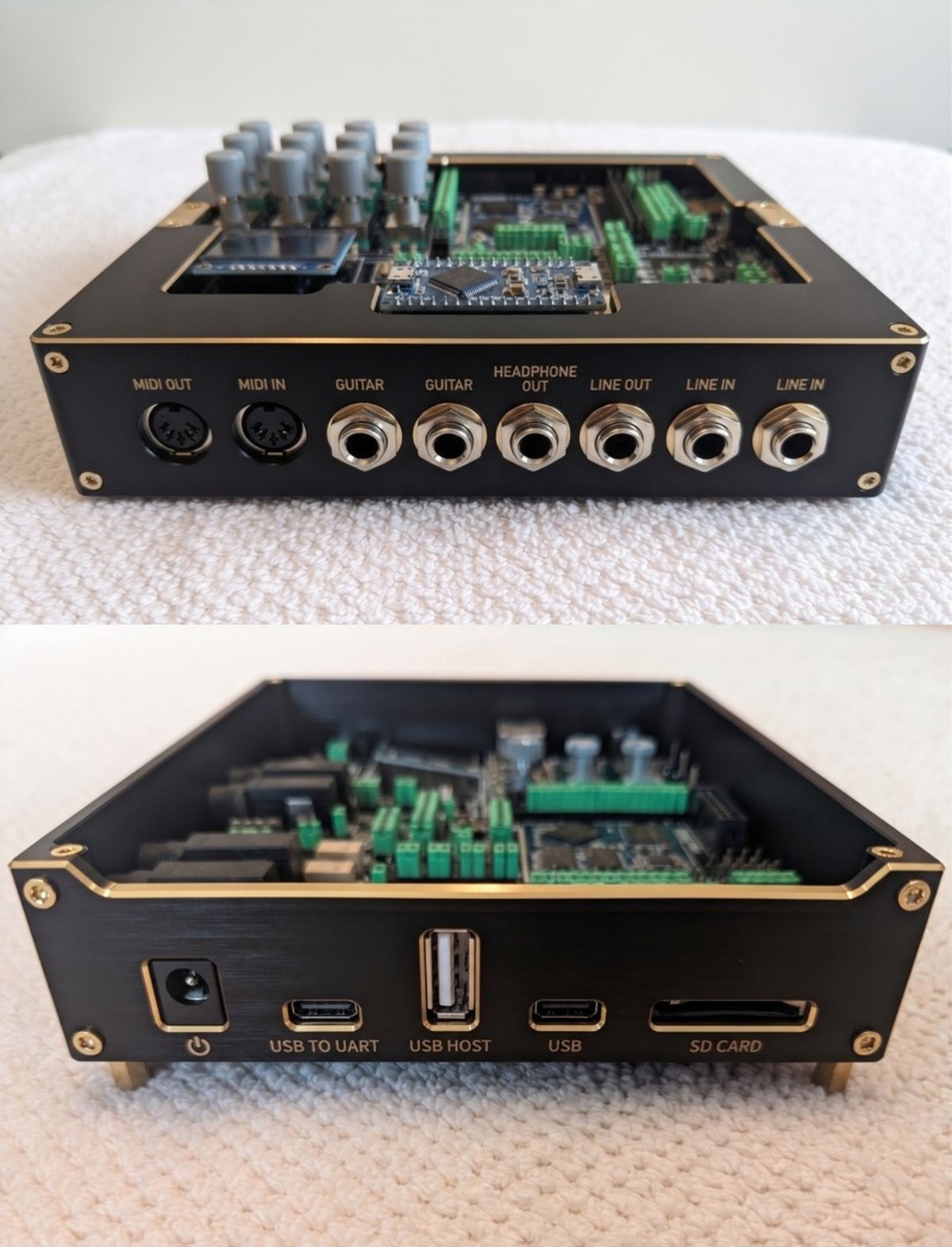
Five voices, on a stock pedal.
HRN SXTN runs the whole harmony engine — chord intelligence, live pitch tracking and five voices of formant-preserving pitch shifting — inside the 1.333 ms audio callback of a $399 Elk Stomp. No server, no network, no second box. First place at the Elk Audio Challenge, MUTEK Montreal.
- Average block, whole engine0.82 ms of 1.333 ms
- Worst block, whole engine1.11 ms of 1.333 ms
- DropoutsZero xruns across three sweeps
- Voices5, at +0.005× marginal cost each
- BoardSTM32MP157 · Cortex-A7 @ 800 MHz
- HostElk Audio OS 1.2.2 · Sushi 1.3.0
Figures are the whole engine block at five voices — the timer that determines whether a buffer drops — at 48 kHz with a 64-sample buffer on the performance governor. Harness and raw CSV are public.
THE DESIGN PROBLEM
Built for a player with no free hands
A guitarist reaches down between phrases. A saxophone player never can — both hands are on the horn and the mouthpiece is in their mouth. So every knob is a soundcheck control, and everything that happens during a tune happens with a foot, or happens by itself.
The corollary matters more than the switches: when the pitch tracker loses confidence, the section steps back to dry rather than guessing. A wrong note inside a horn section sounds like the player's mistake, and that is not a risk worth taking on a stage.
On stage
- Tap engageThe section arrives
- Hold engageEverything drops to dry
- Tap tempoSets the clock, or next chorus
- ExpressionRides mix or voice count
The control surface is built with the Elk Rig Builder, which maps pots and switches to plugin parameters without writing a config by hand.
TWO WAYS IN
Saxophone
Mic the horn as you already do, through the preamp you already own, and take its line output into the pedal. Set the trim once at soundcheck. The rig is the one you have been carrying for years, with one more box in it.
- PathMic → preamp → GUITAR IN L
- PitchTracked from the signal
Wind controller
A Roland Aerophone can go in two ways. Its quarter-inch output works exactly like the sax path. Or connect it over USB, let it name the note directly, and use the horn's audio as the material being shifted — then breath becomes a continuous control over the section.
- AudioVerified on engine channel 0
- USB MIDIEnumerates with no driver work
- BreathCC2, mapped at the host
Breath is not handled inside the plugin. Sushi maps CC2 onto a parameter, which is why the behaviour is a property of the rig file rather than of the build.
STATE
A working prototype, not a product
You cannot buy this. The pedal is a measurement instrument first — built to answer whether a deterministic harmony engine survives a hard real-time callback on commodity hardware, and kept honest by publishing the harness and the raw data rather than a claim.
It answers that question. What it has not had is players: everything measured so far was measured by the person who built it, on one board, with one horn. The next useful thing is not more headroom. It is three horn players who are not us.
Concept render — not a photograph